Introduction
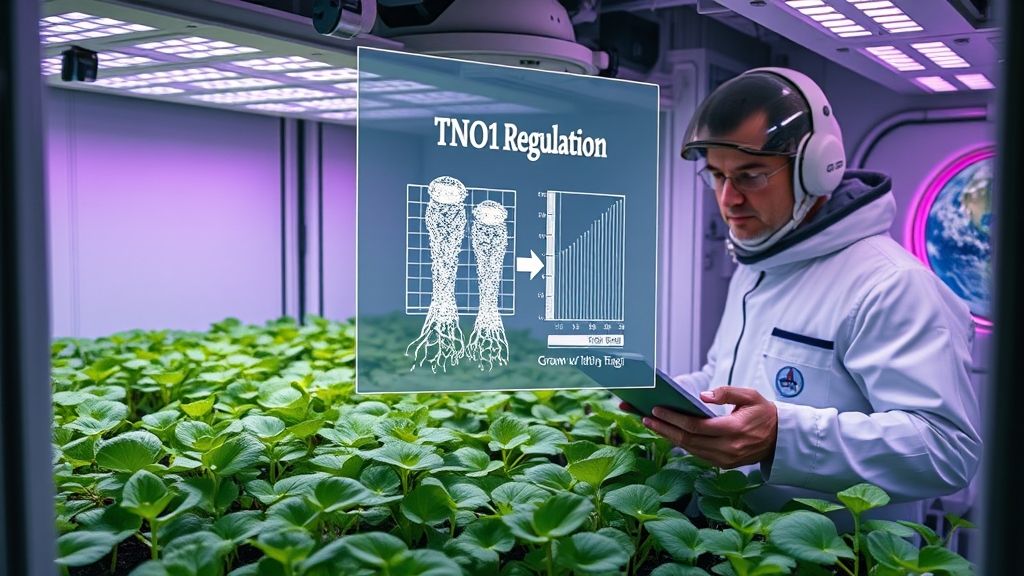
For plants to thrive, their roots must effectively navigate complex environments like soil to find water and nutrients. On Earth, this process is guided by gravity, touch, and other cues. Understanding the cellular machinery that controls this directional growth is crucial for cultivating plants in controlled environments, such as those planned for future space missions. This NASA-funded study investigates the role of a specific protein, TNO1 (TGN-localized SYP41-interacting protein), in modulating the characteristic “skewing” and “waving” movements of plant roots as they grow on a hard surface.
Research Objective
The study aimed to elucidate the function of the TNO1 protein, known to be involved in intracellular trafficking at the trans-Golgi network (TGN), in the context of root directional growth. The primary goals were to:
- Determine if the absence of TNO1 affects root skewing and epidermal cell file rotation (CFR), a key cellular process underlying root twisting.
- Investigate the relationship between TNO1’s function and the stability and organization of the microtubule cytoskeleton, which governs cell expansion.
- Assess how TNO1 contributes to maintaining proper cell morphology and anisotropic growth under conditions of cytoskeletal stress.
Key Findings
The research revealed that TNO1 acts as a crucial negative regulator of root skewing through a mechanism linked to microtubule dynamics.
- Arabidopsis plants lacking the TNO1 protein (tno1 mutants) exhibited exaggerated rightward root skewing when grown on a slanted, impenetrable surface.
- This enhanced skewing was strongly correlated with a significant increase in the left-handed twist of epidermal cell files, known as cell file rotation (CFR).
- Treatment with taxol, a microtubule-stabilizing drug, further amplified the skewing and CFR phenotype in tno1 mutants, indicating a connection to microtubule stability.
- In contrast, tno1 mutant roots were unresponsive to the skew-inducing effects of propyzamide (PPD), a microtubule-destabilizing drug that increased skewing in normal plants.
- Despite these effects, the fundamental orientation of microtubule arrays in the root cells of tno1 mutants remained normal, suggesting TNO1’s role is independent of large-scale cytoskeletal organization.
- Under PPD treatment, tno1 mutants displayed severe defects in cell shape in mature root zones, highlighting TNO1’s importance in maintaining cell integrity during cytoskeletal stress.
Methodology
- Organisms Studied: The study utilized Arabidopsis thaliana as a model organism, comparing wild-type plants to a tno1 knockout mutant and a genetically complemented line where TNO1 function was restored.
- Experimental Conditions: Root skewing was induced by growing seedlings for 7 days on hard agar plates (1.5% agar) slanted at a 30° angle. Drug sensitivity assays involved growing seedlings on vertical plates containing either taxol or propyzamide to assess the impact of microtubule disruption.
- Key Techniques: Researchers used confocal laser scanning microscopy to visualize and quantify cell file rotation and cell morphology. Immunofluorescence staining of tubulin was employed to analyze the orientation of microtubule arrays within root cells. Root growth parameters were quantified using ImageJ software.
Importance for Space Missions
This research provides fundamental insights into the mechanisms controlling plant root guidance, which is essential for developing robust agricultural systems for long-duration space missions.
- Optimizing Plant Growth Systems: Understanding how proteins like TNO1 regulate root navigation can inform the design of substrates and growth conditions that promote healthy plant development in microgravity.
- Crop Engineering: TNO1 represents a potential genetic target for engineering crops with improved root systems better suited for anchorage and nutrient acquisition in the unique environments of space habitats or planetary surfaces.
- Fundamental Biology: The study highlights the critical interplay between intracellular trafficking, the cytoskeleton, and directional growth. As microgravity is known to affect these cellular processes, this work provides a valuable baseline for predicting how plants will adapt and respond to spaceflight conditions.
Knowledge Gaps & Future Research
While this study identifies TNO1 as a key player in root movement, several questions remain. Future research should focus on:
- Elucidating the precise molecular pathway through which TNO1 influences cell expansion and twisting without altering the primary orientation of microtubule arrays.
- Identifying the specific cargo, such as cell wall components or enzymes, whose trafficking is regulated by TNO1 to control directional growth.
- Investigating the potential interaction between TNO1-mediated trafficking and hormone signaling pathways (e.g., auxin) that are central to plant gravitropism and development.
- Conducting experiments in simulated or actual microgravity to determine if TNO1’s role becomes more or less critical when the strong directional cue of gravity is removed.
Results
This study successfully identifies the trans-Golgi network protein TNO1 as a key regulator that suppresses excessive root skewing in Arabidopsis. The findings establish a critical link between the fidelity of intracellular vesicle trafficking and the dynamic cellular processes that guide root movement. By demonstrating that TNO1’s function is necessary for proper root navigation and cell shape maintenance under stress, this research deepens our understanding of how plants integrate internal cellular machinery with external cues to control their growth and architecture—a process vital for sustaining life on Earth and beyond.