Introduction
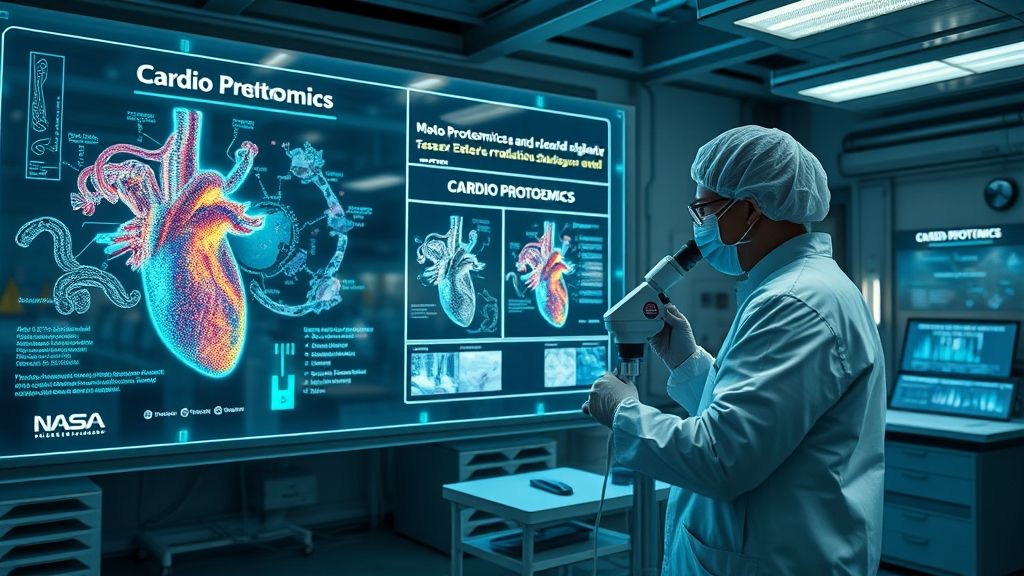
The risk of cardiovascular disease from exposure to the deep space radiation environment is a primary health concern for long-duration missions to the Moon and Mars. While previous studies have documented late-onset heart dysfunction in animal models exposed to simulated space radiation, the underlying molecular mechanisms have remained unclear. This study utilizes advanced proteomic techniques to investigate the long-term changes in heart and plasma proteins following exposure to simulated Galactic Cosmic Rays (GCR), aiming to identify the biological pathways driving cardiovascular damage.
Research Objective
The primary goals of this research were to:
- Characterize long-term changes in the heart and plasma proteome of mice 8 months after a single exposure to simulated GCR.
- Identify specific proteins and biological pathways that are persistently altered by space radiation.
- Investigate the molecular basis for previously observed late-onset cardiovascular dysfunction, such as increased arterial stiffness and reduced heart function.
Key Findings
- A single dose of simulated GCR (150 cGy) caused lasting molecular changes, with the majority of altered proteins being downregulated in both heart and plasma 8 months post-exposure.
- In the heart proteome, 87 proteins were differentially expressed (76 downregulated, 11 upregulated). Key downregulated pathways included mitochondrial function and cell cycle/transcription, suggesting a global reduction in protein synthesis and energy production.
- The most significant discovery was the activation of the Neutrophil Extracellular Trap (NET) formation pathway. Histological analysis confirmed a substantial accumulation of NETs in the heart muscle of irradiated mice at 12 months, which were entirely absent in control animals.
- NETs are web-like structures released by neutrophils that are linked to chronic inflammation, tissue damage, and thrombosis. Their presence may explain previously observed decreased systolic heart function and increased arterial stiffness in these animals.
- Inflammatory pathways related to the complement and coagulation cascades were upregulated in the heart but downregulated in the plasma, indicating a localized, chronic inflammatory response within cardiac tissue.
- Researchers also noted an increased presence of type I collagen in irradiated hearts, a key factor contributing to tissue stiffening and fibrosis.
Methodology
- Organisms: Male C57BL/6 mice, approximately 24 weeks old at the time of irradiation.
- Experimental Conditions: Mice received a single whole-body dose of 150 cGy of simulated Galactic Cosmic Rays (GCR5-ion) at the NASA Space Radiation Laboratory (NSRL). Sham-irradiated mice served as controls. Tissues were analyzed at 8 and 12 months post-exposure.
- Key Techniques: Quantitative mass spectrometry was used for proteomic and phosphoproteomic analysis of heart tissue and proteomic analysis of plasma. Gene Set Enrichment Analysis (GSEA) identified perturbed biological pathways. Immunofluorescence staining was used to visualize NETs and other protein markers in heart tissue sections.
Importance for Space Missions
This study identifies a specific mechanism—NET formation—that likely contributes to the chronic cardiovascular damage caused by space radiation. The link between GCR-induced NETs and thrombosis is critically important, given the documented case of venous thromboembolism (VTE) in an astronaut on the ISS. This research provides a potential biological explanation for increased clotting risk during and after spaceflight. These findings underscore the significant, long-term cardiovascular risks for astronauts on missions beyond Earth’s protective magnetosphere, such as journeys to Mars. Targeting the NET formation pathway could represent a novel strategy for developing medical countermeasures to protect astronaut health.
Knowledge Gaps & Future Research
- What specific molecular signals trigger NET formation after GCR exposure?
- What is the acute-phase response immediately following radiation that initiates this chronic inflammatory state? This requires studies with earlier sampling time points.
- How do these findings in mice translate to human cardiovascular risk, particularly the risk of deep vein thrombosis (DVT) in astronauts?
- Can interventions that inhibit NETs (NETosis inhibitors) effectively prevent or mitigate radiation-induced cardiac damage and thrombosis?
Results
This study provides critical molecular insights into how space radiation causes persistent cardiovascular damage. By identifying the activation of NET formation as a key driver of chronic inflammation, thrombosis, and tissue remodeling in the heart, the research highlights a tangible risk for astronauts and points toward a new avenue for developing targeted countermeasures. Understanding and mitigating these radiation-induced effects is essential for ensuring crew health and mission success on future long-duration exploration missions.