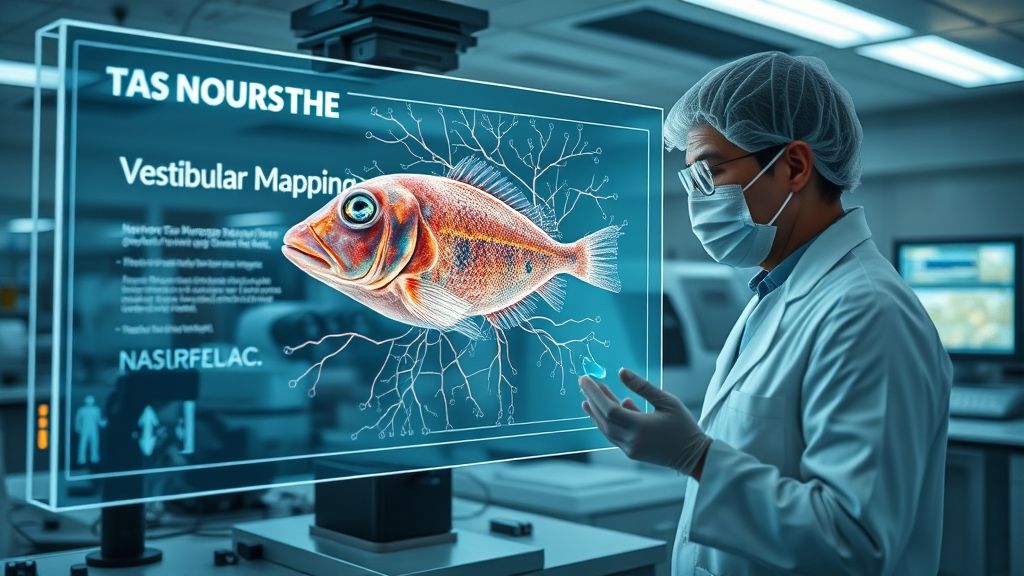
Introduction
The utricle, a key organ in the inner ear, is responsible for sensing gravity and linear acceleration, making it fundamental to balance and spatial orientation. In space, the absence of a constant gravitational pull alters utricular input, leading to space motion sickness and post-flight disorientation in astronauts. The oyster toadfish (Opsanus tau) is a valuable animal model for this research, as previous spaceflight experiments showed its vestibular system becomes extraordinarily hypersensitive after even short missions. This study aimed to create the first comprehensive, high-resolution morphological map of the toadfish utricle to establish an essential anatomical baseline for investigating the structural underpinnings of vestibular adaptation to space.
Research Objective
The primary goals of this research were to:
- Provide a detailed anatomical description of the adult toadfish utricular otolith organ, its sensory epithelium (macula), and neural innervation.
- Utilize advanced microscopy and 3D reconstruction techniques to visualize and quantify the organization of hair cells and their synaptic connections with afferent nerve fibers.
- Establish a foundational morphological framework to serve as a benchmark for future studies on vestibular plasticity in altered gravitational environments.
Key Findings
Using a combination of light, scanning, and transmission electron microscopy, the researchers uncovered a highly organized structure:
- The utricular macula is organized into three distinct zones with varying hair cell densities: a narrow, dense lateral extra-striola (11.8 cells/100μm²), a large medial extra-striola (6.8 cells/100μm²), and a less populated striola (5.5 cells/100μm²).
- Afferent nerve fiber complexity directly correlates with regional hair cell density. Fibers in the complex medial extra-striola average 9.4 terminal boutons, while those in the simpler striola average only 2.5 boutons.
- Synaptic organization is highly specific. A 3D reconstruction revealed that a single afferent fiber is exclusively targeted by a “beam” of hair cells; in one detailed example, 11 of 12 hair cells directed all their synaptic bodies to one afferent.
- Hair cells in the medial extra-striola contain significantly more synaptic bodies than those in the striola (6.92 vs. 4.65 on average, p<0.001), suggesting regional differences in synaptic strength.
- The study identified synaptic contacts on afferent dendrites that lacked obvious specializations like boutons, pointing to the existence of “hidden” synaptic linkages.
- The unique lacinium region contains hair cells oriented parallel to the reversal line, unlike the rest of the macula, suggesting a specialized function for sensing complex, multi-axis movements.
Methodology
- Organisms: Adult oyster toadfish (Opsanus tau) were used as the model system.
- Experimental Approach: This was a ground-based (1G) descriptive study. Afferent nerve fibers were labeled with biocytin for visualization.
- Key Techniques: A multi-scale imaging approach was employed, including scanning electron microscopy (SEM) for surface morphology, transmission electron microscopy (TEM) for ultrastructural synaptic detail, and light microscopy. Computer-aided 3D reconstructions (Neurolucida, ROSS software) were used to map individual neurons and their synaptic fields.
Importance for Space Missions
This research is of high importance for human space exploration. Previous studies on STS-90 and STS-95 found that toadfish vestibular afferents become up to 3 times more sensitive after short-duration spaceflight, mirroring astronaut disorientation upon return to Earth. This foundational study provides the detailed anatomical blueprint needed to investigate the structural basis of this dramatic neuroplasticity. By mapping the precise number and location of synaptic connections in a normal 1G environment, researchers can now identify specific changes—such as an increase in synaptic bodies or altered dendritic branching—that may occur during long-duration missions to the Moon or Mars. This knowledge is critical for understanding vestibular adaptation and developing effective countermeasures for astronaut health and safety.
Knowledge Gaps & Future Research
While this study provides a critical baseline, it also highlights key unanswered questions for future research:
- What specific structural changes occur in the utricle’s hair cells, synapses, and afferent neurons after long-duration exposure to microgravity?
- Are the “hidden” synaptic contacts a site of plasticity, and what is their functional contribution to vestibular signaling?
- How does the efferent vestibular system (signals from the brain to the ear) modulate utricular function, and does its influence change during spaceflight?
- Can the post-flight vestibular hypersensitivity observed in toadfish be directly linked to a quantifiable increase in the number of synaptic ribbons, as hypothesized?
Results
This study successfully delivers a multi-scale, quantitative atlas of the toadfish utricle, revealing a sophisticated and highly organized sensory system. The findings demonstrate a clear structure-function relationship, where distinct anatomical zones and specific neural wiring patterns are optimized for processing gravitational and inertial cues. This work provides the essential ground-truth data necessary to interpret functional changes observed in space-flown animals and moves the field closer to understanding the cellular mechanisms behind vestibular adaptation. Ultimately, this research is a vital step toward safeguarding astronaut balance, orientation, and motor control during and after long-duration space missions.