Introduction
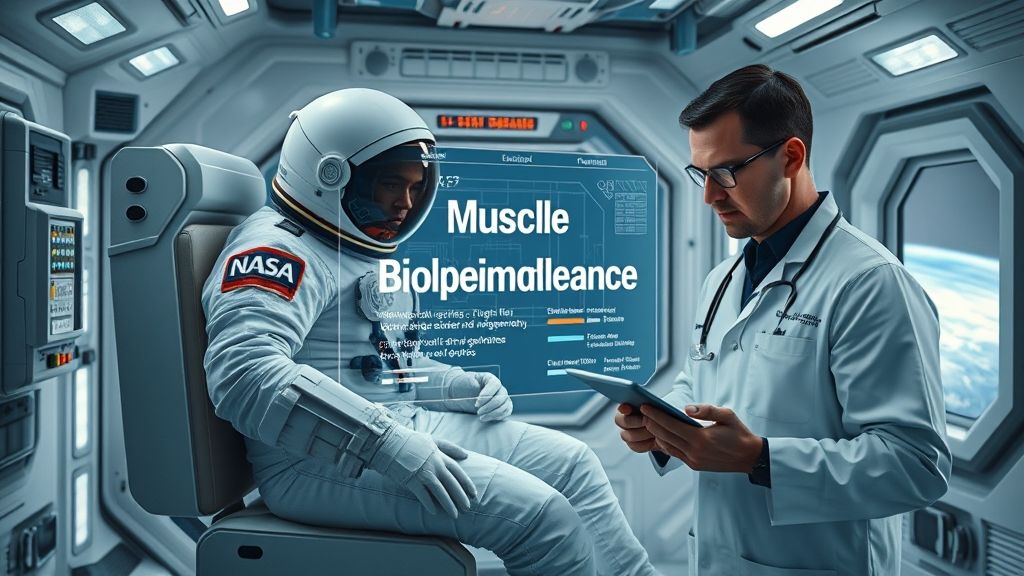
Prolonged exposure to microgravity causes significant muscle and bone deterioration, a major health concern for astronauts on long-duration missions. Current methods for assessing these changes, like DXA scans, are bulky and impractical for use in space. This has driven the search for lightweight, non-invasive diagnostic tools. This study investigates the potential of Electrical Impedance Myography (EIM)—a technique that measures how electrical currents pass through muscle—to detect muscle atrophy caused by spaceflight and simulated microgravity.
Research Objective
The primary goals of this research were to:
- Determine if EIM can detect structural changes in muscle tissue after exposure to microgravity.
- Compare the EIM changes from actual spaceflight with those from hind limb unloading (HLU), a ground-based model for simulating microgravity.
- Assess the correlation between EIM measurements and established markers of musculoskeletal health, such as muscle fiber size and bone mineral density.
Key Findings
The study yielded consistent results across both spaceflight and ground-based simulation experiments:
- An EIM parameter known as the phase-slope was significantly lower in mice exposed to disuse.
- Spaceflight mice showed a 43% reduction in phase-slope compared to ground controls (14.1°/MHz vs. 24.7°/MHz, p=0.0013).
- HLU mice showed a 20.5% reduction compared to their controls (19.0°/MHz vs. 23.9°/MHz, p=0.014).
- As expected, spaceflight caused significant muscle atrophy, with the average muscle fiber cross-sectional area being 39% smaller in spaceflight mice compared to controls (1579 μm² vs. 2591 μm², p=0.013).
- The EIM phase-slope value showed a strong positive correlation with muscle fiber size (ρ=0.65, p=0.011), indicating that EIM is sensitive to cellular-level atrophy.
- Both spaceflight and HLU led to significant reductions in hind limb areal bone mineral density (aBMD).
- Importantly, the EIM phase-slope also correlated significantly with hind limb aBMD in both the spaceflight (ρ=0.65) and HLU (ρ=0.55) groups, suggesting a link between the electrical properties of muscle and regional bone health.
Methodology
- Organisms: The study used 9-week-old female C57Bl/6N mice.
- Experimental Conditions: Two parallel experiments were conducted:
- Spaceflight: 6 mice flew aboard the Space Shuttle Atlantis (STS-135) for 13 days, compared to 8 ground controls.
- Simulated Microgravity: 14 mice underwent hind limb unloading (HLU) for 13 days, compared to 13 normally-loaded controls.
- Key Techniques:
- Electrical Impedance Myography (EIM): Performed on ex vivo gastrocnemius muscle tissue to measure its electrical properties (resistance and reactance) across a range of frequencies.
- Histology: Muscle tissue from the spaceflight group was analyzed to quantify muscle fiber cross-sectional area.
- pDXA: Peripheral dual-energy X-ray absorptiometry was used to measure areal bone mineral density (aBMD) of the hind limb.
Importance for Space Missions
This research provides strong proof-of-concept for EIM as a mission-critical diagnostic tool. Its potential benefits include:
- Non-Invasive Monitoring: EIM offers a rapid, painless, and non-invasive way to track astronaut muscle health in-flight without the need for large, power-hungry equipment.
- Countermeasure Assessment: The technology could be used to provide real-time feedback on the effectiveness of exercise regimens and other countermeasures aimed at preventing muscle atrophy.
- Integrated Health Assessment: The correlation between EIM and bone density suggests it might serve as a proxy indicator for overall musculoskeletal deconditioning, providing a more holistic view of astronaut health.
Knowledge Gaps & Future Research
While promising, these findings highlight the need for further validation and development before EIM can be operationally deployed. Key questions remain:
- Can in-vivo (on-body) EIM measurements reliably track muscle atrophy over time in a longitudinal study?
- How do EIM parameters relate to functional outcomes, such as muscle force and endurance?
- What is the precise temporal relationship between changes in EIM, muscle mass, and bone density during deconditioning and reconditioning?
- To what extent do spaceflight-induced fluid shifts, rather than tissue atrophy alone, contribute to the observed EIM changes?
Results
In summary, this study successfully demonstrates that EIM can detect and quantify muscle atrophy resulting from both spaceflight and simulated microgravity in a mouse model. The consistent findings across two different experimental conditions, and the strong correlation with both muscle fiber size and bone density, validate EIM as a highly promising technology. Further development could lead to a portable, easy-to-use device for monitoring astronaut musculoskeletal health, enabling better management of countermeasures during long-duration missions to the Moon and Mars.